
Car Revs but Won’t Move | Auto Service Experts
If your engine revs freely when you press the gas but your car refuses to move, your transmission has lost the ability to transfer engine power to the wheels. When a car revs but won’t move, it is one of the most alarming transmission symptoms a driver can experience. The engine sounds normal, but nothing happens. This condition is commonly reported on Ford, Chevy, Dodge, Toyota, Honda, and Nissan vehicles and almost always signals a serious internal transmission or drivetrain fault.
When engine power fails to reach the wheels, the diagnostic process draws on the full scope of complete transmission diagnosis and repair that our team applies to internal mechanical failure, torque converter faults, and drivetrain issues. At Auto Service Experts in San Antonio, our ASE-certified technicians use structured diagnostic testing to identify the exact cause before any parts are replaced.
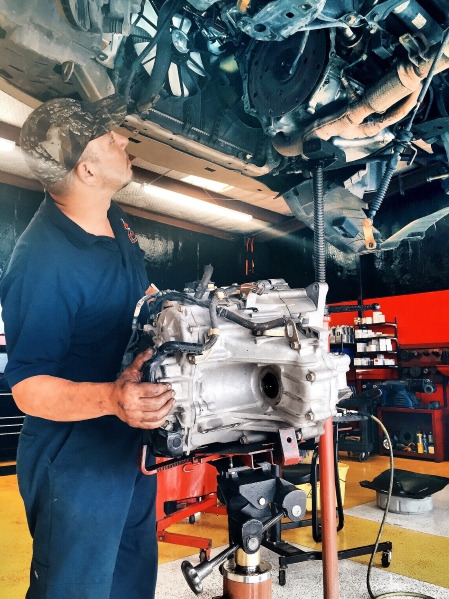
Car Revs but Won’t Move Diagnostic Overview
This page is part of the Transmission Diagnostic Support Series at Auto Service Experts in San Antonio and is designed to answer one primary concern: why does my car rev but not move, and what is causing it?
This condition means the engine is producing power normally, but that power is not being transferred to the drivetrain. This happens in an automatic transmission when the torque converter has failed, the transmission has lost all hydraulic pressure, or internal clutch components have completely failed. In some cases, the vehicle may move very slowly or creep weakly before stalling in place. In others, there is no movement at all, regardless of how much throttle is applied.
Diagnostic Snapshot
When a car revs but does not move, the transmission has either lost all hydraulic pressure, experienced complete internal clutch failure, or the torque converter is no longer transferring engine torque to the transmission input shaft. Diagnosis begins with transmission fault code retrieval, hydraulic line pressure testing, and torque converter stall speed evaluation before any components are replaced.
This guide explains the verified causes of this condition, which internal systems have failed, and how structured diagnostic testing identifies the exact fault before any repair is performed. For complete transmission system coverage, visit our main Transmission System Authority Hub.
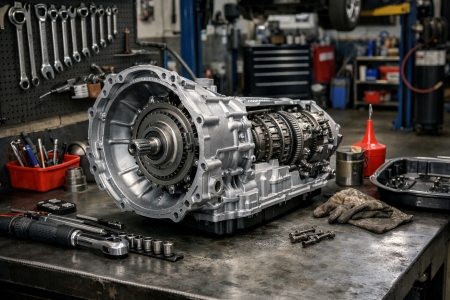
What Drivers Typically Feel When the Engine Revs but Car Doesn’t Move
When a car revs but doesn’t move, drivers commonly report:
- Engine RPM rises normally with throttle input, but the vehicle stays stationary
- No resistance or engagement felt through the drivetrain when placed in gear
- A slight creep or very weak movement followed by no further acceleration
- Transmission warning light or check engine light illuminated
- A burning smell from overheated transmission fluid or clutch material
- The condition is present in both drive and reverse, or only in forward gears
Why Proper Diagnostics Matter When You Press the Gas and Car Doesn’t move
A car that revs without moving can result from a completely failed torque converter, total hydraulic pressure loss, a broken transmission output shaft, or complete clutch pack failure. Each of these conditions requires a different repair approach. Without structured testing, it is common to assume total transmission failure when the actual root cause may be a failed torque converter, a snapped output shaft, or critically low fluid from an undetected leak.
At Auto Service Experts, our auto diagnostic specialists perform in-depth evaluations, including fault code retrieval, hydraulic stall pressure testing, torque converter evaluation, fluid level and condition inspection, and drivetrain integrity verification. Accurate diagnosis determines the actual scope of the repair before any internal work is authorized.
Common Verified Causes When Your Car Revs but Won’t Move
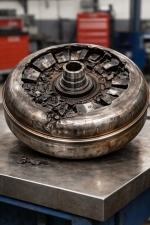
Complete Torque Converter Failure
The torque converter is the fluid coupling between the engine and the transmission. When the internal fins, stator, or pump drive fail completely, the converter cannot transfer engine torque to the transmission input shaft. The engine revs freely with no power delivered to the drivetrain. Confirmed through stall speed testing and torque converter evaluation.
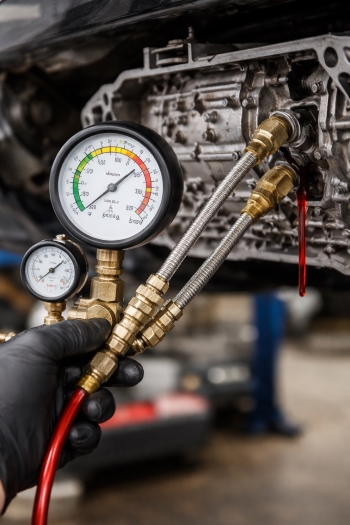
Total Hydraulic Pressure Loss
Complete loss of hydraulic line pressure prevents any clutch pack from engaging. This can result from a failed transmission pump, critically low fluid from a major leak, or a catastrophic internal seal failure. Confirmed through hydraulic line pressure testing at idle and under stall conditions.
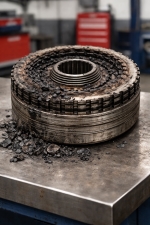
Complete Forward Clutch Pack Failure
When the forward clutch pack has completely burned or disintegrated, no forward gear can engage regardless of hydraulic pressure. The engine revs with no resistance felt in the drivetrain. Confirmed through hydraulic pressure testing and internal inspection.
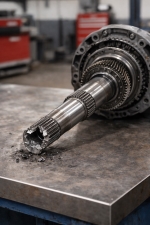
Broken or Damaged Output Shaft
A fractured output shaft or broken planetary gear set severs the mechanical connection between the transmission and the driveshaft. The transmission may function internally but cannot deliver power to the wheels. Confirmed through drivetrain inspection and stall testing.
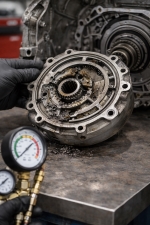
Failed Transmission Pump
The transmission pump generates all hydraulic pressure. A seized or failed pump produces no pressure whatsoever, preventing any gear engagement. This is often accompanied by a whining or grinding noise at idle. Confirmed through hydraulic pressure testing and pump inspection.
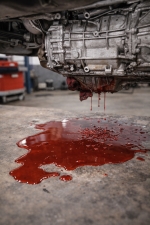
Critically Low or Empty Transmission Fluid
A transmission that has lost most or all of its fluid through a major leak cannot generate hydraulic pressure. The engine revs normally while the transmission sits completely disengaged. Confirmed through fluid level inspection and leak source identification.
Professional Diagnostic Process
At Auto Service Experts, every car that revs but won’t move is evaluated through our ASE CodeLogic diagnostic workflow before any repair recommendation is made.
Verified Transmission Diagnostic Protocol
- Verify customer concern and document whether no movement occurs in all gears or specific gears only
- Check the transmission fluid level and condition before any other testing
- Retrieve stored and pending transmission fault codes
- Perform a hydraulic line pressure test at idle and under stall conditions
- Perform a torque converter stall speed test to evaluate converter function
- Inspect undercarriage for driveshaft, axle, and output shaft integrity
- Monitor solenoid command and response data via scan tool
- Perform bidirectional solenoid and pump functional test via scan tool
- Confirm repair scope with a full internal inspection report before any work is authorized
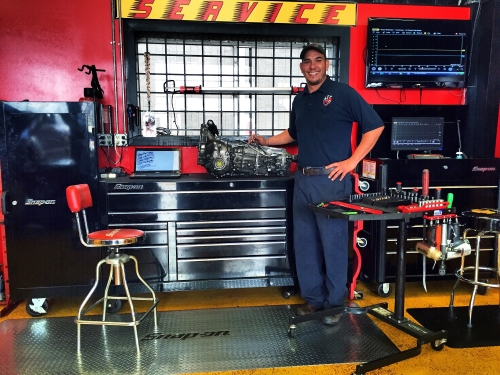
A car that revs but won’t move can point to several distinct failure points, including torque converter failure, broken transmission bands, complete clutch pack failure, or a snapped input shaft. We do not recommend any repair until testing confirms the exact cause and whether secondary damage has occurred from operating the vehicle in a failed condition.
Parts Commonly Replaced During Transmission Fluid Leak Repair
Torque Converter
The torque converter couples engine power to the transmission through hydraulic fluid. Complete internal failure (including fin damage, stator failure, or pump drive separation) prevents any torque from reaching the transmission input shaft, causing the engine to rev freely with no vehicle movement.
Transmission Pump
The transmission pump generates all the hydraulic pressure required for clutch engagement. A seized or failed pump produces no line pressure, preventing any gear from engaging. Pump failure is often accompanied by noise and results in the complete loss of drive.
Forward Clutch Pack
The forward clutch pack is the primary mechanical component that locks the drivetrain into forward motion. Complete friction material failure prevents any engagement regardless of hydraulic pressure and requires internal transmission disassembly for replacement.
Output Shaft or Planetary Gear Set
A broken output shaft or shattered planetary gear set severs the mechanical power path between the transmission and the driveshaft. This condition requires internal transmission inspection and component replacement or a full rebuild, depending on the extent of damage.
Transmission Fluid and Filter
Critically low or contaminated fluid is a direct cause of complete hydraulic pressure loss. A full fluid service is performed as part of any repair where fluid starvation is confirmed as a contributing factor.
Transmission Control Module
In rare cases, a completely failed transmission control module may prevent all solenoid commands from being issued, resulting in no gear engagement. Confirmed through module communication testing before any mechanical disassembly is performed.
When A Car or Truck that revs but doesn’t move is NOT
A vehicle that revs but does not move is occasionally mistaken for other conditions. Proper differential diagnosis separates it from:
Severe Transmission Slipping
A transmission that slips severely may feel similar to no movement, but some power transfer occurs, and the vehicle moves weakly. True no-movement with high revs indicates complete engagement failure rather than partial slipping.
Broken Driveshaft or CV Axle
A completely snapped driveshaft or CV axle can cause a car to rev with no movement, but the fault lies in the drivetrain rather than the transmission itself. Confirmed through undercarriage inspection before any transmission work is performed.
Seized Brake or Parking Brake
A fully engaged parking brake or a seized rear brake caliper can prevent movement even with normal transmission function. Confirmed through brake system inspection before transmission diagnosis is initiated.
Condition-Specific Diagnosis
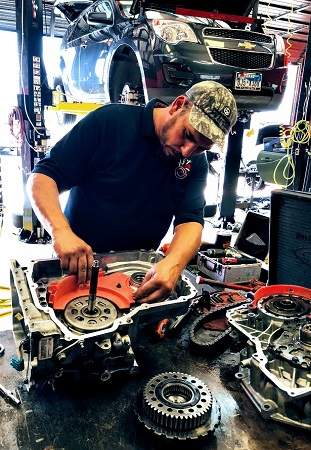
The specific conditions under which the car revs without moving provide critical diagnostic information about which system has failed.
- No Movement in Any Gear (Drive or Reverse): Complete loss of movement in all gears points to a pump failure, total hydraulic pressure loss, torque converter failure, or a broken output shaft affecting all gear ranges.
- No Movement in Drive Only (Reverse Works): Forward engagement failure with functioning reverse indicates the fault is isolated to the forward clutch circuit, forward solenoid, or forward clutch pack specifically.
- Very Weak Movement That Dies Immediately: A brief creep followed by stalling in place suggests a partially functioning torque converter or a clutch pack with minimal remaining friction material.
- No Movement When Cold (Improves Slightly When Warm): A cold-only no-movement condition suggests a pump that cannot build pressure when cold, or a torque converter that requires operating temperature to partially engage.
- Sudden Loss of Movement After Normal Operation: A transmission that was functioning normally and then suddenly produced no movement suggests a catastrophic internal failure, such as a broken output shaft, a snapped planetary gear, or a sudden complete pump failure.
Diagnosis requires hydraulic stall-pressure testing, torque-converter evaluation, and a full drivetrain integrity inspection.
Safety Considerations When Car Revs but Won’t Move
A car that revs but does not move should not be driven under any circumstances. Attempting to force movement by applying more throttle with a failed transmission accelerates internal damage, overheats the transmission fluid, and can cause catastrophic component failure, turning a repairable condition into a complete transmission replacement.
If your vehicle suddenly loses movement while driving, pull safely to the side of the road, shift to park, and do not attempt to re-engage drive. Continued attempts to move the vehicle under power can destroy remaining internal components within minutes.
Drivers in San Antonio experiencing this condition should have the vehicle towed to our shop rather than driven. Call our San Antonio shop and our service team will arrange prompt diagnosis, advise on towing, and let you know whether a loaner or shuttle is available while your vehicle is being evaluated. Initial diagnostic testing is completed the same day, so you will know the full scope of the repair before any decision is made.
How Repeat Transmission Failures are Prevented
Long-term reliability is achieved by:
- Inspecting the torque converter, pump, and input shaft seal whenever internal transmission work is performed
- Verifying hydraulic line pressure meets specification before closing the transmission after any internal repair
- Performing a complete fluid and filter service with the correct OEM-specified fluid after any internal repair
- Confirming output shaft and planetary gear set integrity before reassembly
- Clearing all fault codes and adaptive data after repair and allowing full system relearn
- Performing a complete multi-range road test and hydraulic pressure recheck before vehicle return
Final verification testing confirms full power transfer is restored before the vehicle leaves the shop.
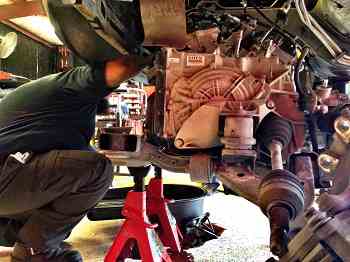
Related Transmission Symptoms
Explore other Transmission Diagnostic Support pages:
- A car that revs but won’t move shares several root causes with transmission slip, particularly when partial drive is present before full engagement failure occurs. If the vehicle moves but loses power or flares under acceleration, our Transmission Slipping and Gear Slip Diagnosis page covers the hydraulic and clutch pack conditions behind that related symptom.
- Complete loss of drive is often the end result of an engagement problem that began as a hesitation or delay before the transmission would move the vehicle. Our Transmission Won’t Engage or Delays Going Into Drive page covers the hydraulic pressure and solenoid faults that lead to progressive engagement failure.
- In some cases, a vehicle that won’t move forward still produces harsh or abrupt behavior when attempting reverse or when partial drive is restored during warm-up. Those shift quality concerns are covered on our Transmission Jerks and Bangs During Gear Changes page.
- Severe internal failure that causes complete loss of drive frequently displaces fluid through seals and gaskets under abnormal pressure conditions. If a fluid puddle has appeared under the vehicle alongside the no-movement symptom, our Transmission Fluid Leak and Seal Inspection page outlines how leak sources are identified and evaluated for secondary damage.
- A transmission that fails to move the vehicle almost always generates fault codes that activate the warning indicator, and in many cases, the light appears before complete drive loss occurs. Our Transmission Warning Light and Fault Code Evaluation page explains what the control module records during these failure events and how stored codes guide the diagnostic process.
Frequently Asked Questions When a Car Revs but Won’t Move
Why does my car rev but not move?
The engine is producing power normally but the transmission is no longer transferring that power to the wheels. The most common causes are a failed torque converter, complete hydraulic pressure loss, or total forward clutch pack failure.
Can I drive a car that revs but won’t move?
No. Attempting to drive with this condition can cause rapid internal damage and turn a repairable transmission into one that requires complete replacement. The vehicle should be towed to a shop for diagnosis.
Does a car that revs but won’t move always need a full transmission rebuild?
Not always. If the root cause is a failed torque converter, pump, or a critically low fluid level due to a leak, the repair may be limited to those components. Internal inspection determines the true scope before any rebuild decision is made.
What does it mean if the car moves in reverse but not in drive?
This isolates the fault to the forward clutch circuit specifically — the forward solenoid, forward clutch pack, or the valve body circuit that controls forward gear engagement. Reverse uses a separate clutch circuit that remains functional.
Could a broken driveshaft cause my car to rev without moving?
Yes. A completely snapped driveshaft or CV axle severs the mechanical connection between the transmission and the wheels. This is confirmed during undercarriage inspection before any transmission work is performed.
How much does it cost to fix a car that revs but won’t move?
Cost depends entirely on the verified root cause. A torque converter replacement differs significantly from a full internal rebuild. Diagnostic testing determines the exact scope, so you receive an accurate repair estimate before any work begins.
Have Transmission Leak Diagnostic or Repair Questions?
Call 210-495-6688 now to speak with an ASE-Certified Transmission Specialist or automotive service consultant.