
Driveshaft, U-Joint & CV Axle Repair In San Antonio, TX
Driveshaft, U-Joint & CV Axle problems have a clear pattern — a clunk when shifting, vibration at highway speed, or a clicking noise when turning. The challenge is that these symptoms overlap with transmission, suspension, and tire issues. We figure out the exact source before anything gets replaced.
A 2020 Silverado came in clunking on every shift into Drive — the owner was sure it was the transmission. Twenty minutes on the lift confirmed a worn U-joint. We serve Stone Oak, Castle Hills, Shavano Park, Thousand Oaks, and Alamo Heights.
How the Driveshaft & CV Axle System Works
The driveshaft, U-joints, CV axles, and carrier bearing work together to move power from the transmission to the wheels. When one component begins to fail, it places added stress on the rest of the system. Symptoms do not always point to a single failed part — they indicate where in the system the breakdown is occurring.
The Driveshaft
Found in RWD and 4WD vehicles, the driveshaft carries rotational torque from the transmission to the rear axle or transfer case. Driveshaft imbalance or wear produces vibration that increases with vehicle speed and does not change with steering input.
U-Joints
Universal joints connect driveshaft segments and allow the shaft to articulate through suspension travel. As U-joints wear, rotational slack develops. The result is a clunk or shudder felt when the drivetrain engages or when transitioning between acceleration and deceleration.
CV Axles
Constant velocity axles are used in FWD and AWD vehicles to deliver torque to the front wheels while maintaining smooth power transfer through a full range of steering and suspension angles. When a CV joint begins to fail, clicking or vibration becomes detectable — often only under specific load conditions.
Inner vs. Outer CV Joints
Outer CV joints handle steering angles and typically produce a clicking sound during turns when worn. Inner CV joints handle suspension travel and tend to produce vibration under acceleration, especially when the joint is loaded at an extreme angle.
The CV Boot
The CV boot seals the joint and retains the grease that lubricates it. A torn or cracked boot allows moisture and road debris to contaminate the joint. Once contaminated, wear accelerates rapidly. Replacing a boot early prevents joint replacement later.
The Carrier Bearing
The carrier bearing supports the center of a two-piece driveshaft. When the rubber isolator in the carrier bearing wears, it produces vibration that occurs within a specific speed range. This is often misdiagnosed as a tire balance issue because it follows shaft speed, not wheel speed.
Driveshaft & CV Axle Services We Perform


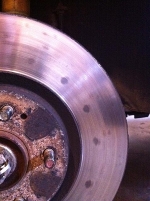
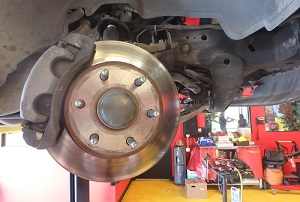
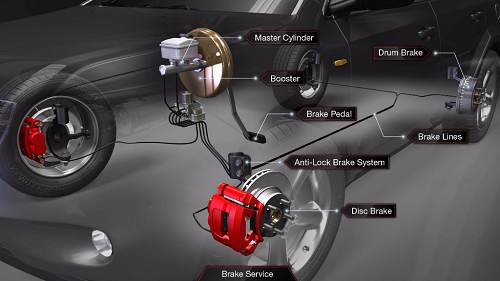
Brake Pad Replacement

Brake pad replacement starts with confirming the concern and checking the condition of the brake system. What this service includes:
– Road test when needed to confirm noise, pull, vibration, pedal feel, or warning lights
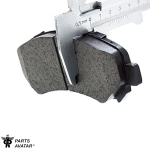
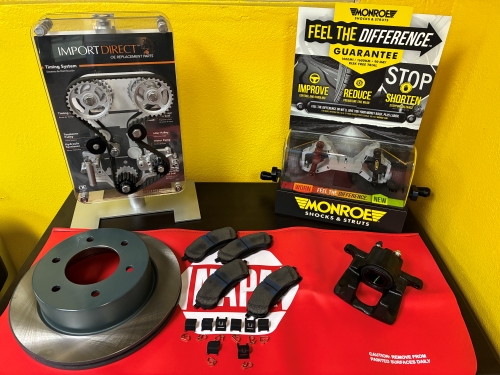
– Remove the wheels and inspect pad thickness, rotor condition, caliper movement, slide operation, and hardware condition
– Remove old pads and hardware
– Compress the caliper pistons correctly
– Clean and inspect the contact points
– Install new brake pads with the proper hardware
– Verify caliper movement and proper reassembly
– Confirm pedal feel and road test when needed
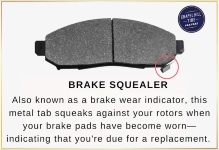
If your brakes are squeaking, grinding, or wearing unevenly, your brake pads should be inspected. For brake pad replacement in San Antonio, we inspect the full system before recommending parts so you get the repair your vehicle actually needs.


CV Axle Diagnosis and Replacement
We evaluate both inner and outer joints independently, checking boot condition, grease contamination, and joint play. We confirm the axle is the source of the symptom before recommending replacement — and we verify which joint has failed, not just which axle.
Driveshaft and U-Joint Service
We check rotational integrity, balance condition, and slip yoke operation. On vehicles with a history of prior driveline repairs, we inspect for incorrect U-joint phasing or improper installation that can produce vibration even with new parts.
Carrier Bearing and Center Support
We diagnose speed-range vibration by separating driveshaft speed from wheel speed through testing. We inspect the rubber isolator condition and center support bracket, and verify proper shaft alignment after any carrier bearing replacement.
Complete Driveline Inspection
We test under load and coast, straight and in turns, at multiple speed ranges. The inspection includes a physical check of all boots, joint play, shaft balance, and mounting hardware — to identify what is failing and what is still within tolerance.
Shop & Mechanic Certifications & Professional Recognitions
- ASE Master Certified Technicians (National Institute for Automotive Service Excellence)
- AAA Approved Auto Repair Facility
- BBB Accredited Business (A+ Rating)
- RepairPal Certified Facility
- TechNet Professional Auto Service Center
- NAPA AutoCare Center
- Dealer-quality repair without dealer pricing
- OEM & factory quality parts
- Auto AC EPA Section 609 MVAC Certification
- Complete 3 Year / 36,000-mile warranty on all repairs
- Same-day service when available
- ASE Certified Driveline Repair Specialists
- FREE diagnostics with approved repair
- Complimentary Shuttle service for 5 mi radius
Common Driveshaft, U-Joint & CV Axle Problems – Diagnostic Support Series
Clunking When Shifting
A clunk on every shift into Drive or Reverse usually points to a worn U-joint or loose driveshaft yoke — not the transmission. The impact is brief and repeatable, especially under acceleration load.
What you feel: a thud or clunk when the drivetrain loads up, most noticeable shifting into Drive or Reverse.
Vibration at Highway Speed
A steady vibration that starts between 55–75 mph and holds at a consistent frequency usually comes from a driveshaft imbalance or worn CV joint — not tire balance. Tire-related vibration typically changes after rotation or rebalancing. Driveline vibration doesn’t.
What you feel: a smooth, consistent vibration that holds at highway speed and doesn’t change after tire service.
Clicking When Turning
A popping or clicking sound during turns — especially low-speed turns — is a classic outer CV joint symptom. The joint is worn and binding as the axle articulates through the turn. This is specific to CV axles and not related to steering or suspension.
What you hear: a rhythmic pop or click that gets faster as you turn tighter or accelerate out of a turn.
Grease on Wheel or Undercarriage
Grease on the inner face of a wheel or inside the wheel well usually means a torn CV boot. When the boot splits, grease packs out and the joint is exposed to dirt and moisture. This is often caught before full joint failure — and it’s much cheaper to address early.
What you see: dark grease smeared on the inner wheel face, inside the wheel well, or on the undercarriage near the axle.
Vibration That Doesn’t Change After Tire Service
When a vibration stays consistent after new tires, balancing, and rotation, the source is likely the driveline — not the wheels. Worn CV joints, a driveshaft imbalance, or a failing center support bearing all produce vibration that wheel service won’t fix.
What you notice: the vibration persists at the same speed and intensity even after tires have been replaced, balanced, and rotated.
Traction Control or ABS Light with Driveline Symptoms
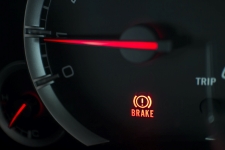
A traction control or ABS warning light that appears with driveline symptoms — clunking, vibration, or pulling — may indicate a wheel speed sensor being affected by a worn CV joint or damaged axle. The light is a clue, not the cause. We scan the system and verify what’s actually triggering it.
What you see: a traction control or ABS warning light that came on alongside a driveline symptom — not as a standalone issue.
Common Driveshaft, U-Joint & CV Axle Problems by Make and Model
Driveline component failures follow patterns by platform and powertrain design. Here is what we see most often at the shop in San Antonio.
Ford & Lincoln
F-150, Expedition, Explorer, Escape, Edge, and Navigator owners frequently present with driveshaft vibration and U-joint clunk in 4WD models, and CV axle vibration in AWD variants. High-mileage F-150s and Expeditions are particularly common in our diagnostic bay for front driveshaft and slip yoke issues.
Dodge, Ram & Jeep
Ram 1500 and 2500 owners report U-joint wear and driveshaft clunk, particularly after 80,000 miles. Wrangler and Grand Cherokee owners on lifted suspensions frequently experience premature driveline wear from altered driveshaft angles. Durango and Charger AWD models present with CV axle vibration under acceleration.
Chevrolet, GMC, Buick & Cadillac
Silverado and Sierra trucks are frequent visitors for carrier bearing wear and driveshaft imbalance. Tahoe, Yukon, and Escalade owners report clunk on engagement that traces to worn U-joints. Enclave and Traverse AWD models frequently develop inner CV joint vibration under load.
Toyota & Lexus
Camry, Corolla, RAV4, and Highlander are common for outer CV joint clicking, often caused by boot failure that allowed joint contamination. RX and GX models with AWD frequently develop inner CV joint issues that produce vibration during acceleration at low speeds.
Honda & Acura
Accord and Civic owners present frequently with inner CV joint vibration under load — a known characteristic of the Honda platform at higher mileage. CR-V and Pilot owners report clicking turns and occasional shudder. TLX and MDX see inner joint wear with AWD torque loading.
Nissan & Infiniti
Altima, Maxima, and Sentra owners report clicking CV joints, often traced to outer joint wear accelerated by boot failure. Rogue and Pathfinder AWD models develop inner joint vibration under load. QX60 and Q50 owners see CV axle issues that produce noticeable vibration during acceleration.
What These Symptoms Are Not
Driveline symptoms are frequently misread because they share characteristics with problems in adjacent systems. Understanding what the symptom is not is part of arriving at an accurate diagnosis.
Not a Transmission Problem
A clunk felt when shifting into drive or reverse is often attributed to the transmission. In most cases, the transmission shifts cleanly — the clunk originates in a worn U-joint, a worn slip yoke, or loose differential mounts. The drivetrain is moving before the transmission fault response would appear.
Not a Tire or Wheel Balance Issue
Tire balance vibration follows wheel speed and is influenced by tire load. Driveshaft vibration follows shaft speed, which is not identical to wheel speed in all drive configurations. If vibration does not respond to a wheel balance service, the driveshaft is the more likely source.
Not a Suspension Problem
CV joint and carrier bearing symptoms respond to vehicle speed and drivetrain load. Suspension wear responds to road surface input and cornering load. If the vibration or noise is consistent on smooth roads and tied to speed or throttle position, the driveline is the priority to inspect.
Not an Engine or Drivetrain Mount Issue
Engine and transmission mount wear produces vibration at idle that diminishes at speed. Driveline clunk and vibration are load-dependent and engagement-specific. If the symptom requires the vehicle to be moving and under power, mounts are generally not the primary cause.
Not a Reason to Replace a Sensor
A traction control or AWD fault code does not mean the sensor is defective. The sensor is accurately reporting a rotational speed discrepancy caused by a mechanical fault in the driveline. Replacing the sensor leaves the underlying mechanical problem unresolved.
Not a Wheel Bearing
Wheel bearing noise increases under lateral load and is typically present whether the vehicle is in drive or neutral. CV joint clicking is angle-dependent and usually appears only during turns under power. Carrier bearing vibration follows shaft speed, not the load-transfer pattern of a wheel bearing.
Complete Driveline Services:
- CV Axle Replacement
- U-Joint Replacement
- Driveshaft Repair & Replacement
- CV Boot Replacement
- Center Support Bearing Service
- Complete Driveline Inspection
How We Diagnose Driveshaft, U-Joint & CV Axle Problems In San Antonio
We follow a structured process so the diagnosis is repeatable and the repair is confirmed:
- Road test to confirm the symptom — speed, load condition, and direction of the noise or vibration.
- Lift the vehicle and inspect U-joints, CV axles, driveshaft, and center support bearings.
- Check for boot tears, grease leakage, and visible wear at the joints.
- Test U-joints for rotational play and CV axle shafts for binding or looseness.
- Check driveshaft balance, runout, and yoke condition where applicable.
- Confirm the repair with a post-service road test before the vehicle leaves the shop.
Driveline problems often mimic each other — clunking can come from U-joints, CV axles, or differentials. This process is how we figure out which one before anything gets replaced.
How To Prevent Repeat Driveshaft, U-Joint & CV Axle Failures
Most repeat driveline failures trace back to an uncorrected root cause or deferred maintenance. We address the source, not just the symptom:
- Don’t drive on a clicking CV axle — joint failure can happen suddenly and leave you stranded
- Replace CV boots at the first sign of cracking or grease leakage — before the joint fails
- Address U-joint wear when clunking is first noticed — worn joints load the driveshaft unevenly
- Use OEM-spec or better replacement parts — undersized or off-spec axles wear faster under load
- Inspect at every oil change for grease on inner wheel faces — it’s an early warning sign
- Have the driveline inspected if vibration or noise returns after a previous repair
Small problems in driveline components are almost always cheaper to fix early. If you’re hearing something new or feeling a vibration that wasn’t there before, it’s worth getting it checked before the joint or axle reaches the point of failure.
When a Warning Light or Data Code Matters
A traction control or ABS warning light that appears alongside clunking, vibration, or pulling often points to a driveline issue — not just an electronics fault. A damaged CV axle or loose axle nut can disrupt wheel speed sensor signals and trigger these lights. We scan the system, verify input and output signals, and figure out the actual cause before anything gets replaced.
Frequently Asked Questions – Driveshaft & CV Axle Repair In San Antonio
What Does A Clicking Noise When Turning Usually Mean?
A clicking sound during turns is the most common sign of a worn CV joint. When the boot tears and grease leaks out, the joint runs dry and makes contact under load. We inspect the boot condition and the joint for play before recommending replacement.
Can I Keep Driving With A Clunking Driveshaft?
Early-stage clunking from a worn U-joint can be driven short distances, but a severely worn joint can seize or separate — dropping the driveshaft and creating a serious safety hazard. If the noise has changed or gotten louder, get it inspected before driving further.
What Is The Difference Between A CV Axle And A Driveshaft?
A CV axle connects the transmission to the front wheels on FWD vehicles. A driveshaft connects the transmission to the rear axle on RWD and 4WD vehicles. Both transfer engine power to the wheels but fail differently. We identify which component is involved before any work begins.
How Do I Know If A CV Boot Is Bad Versus The CV Joint Itself?
A torn CV boot is visible — it lets grease escape. If caught early, before the joint runs dry, only the boot may need replacement. If the joint has been running without lubrication, the joint itself needs to be replaced. We inspect both during every driveline evaluation.
What Causes Vibration That Gets Worse At Highway Speed?
Speed-related vibration usually points to a driveshaft that is out of balance, has worn U-joints, or has been bent. It can also come from worn CV axles, differential issues, or wheel bearing problems. Each has a distinct pattern under acceleration or steady speed. We road test and measure to isolate the exact source.
Will My AWD System Be Damaged If I Ignore A CV Axle Problem?
Yes. A failing CV axle on an AWD vehicle puts stress on the transfer case and differential, which are significantly more expensive to repair. Catching the axle early prevents that cascade. If you’re hearing noise on turns or feeling vibration, get it inspected before the repair scope grows.
How Long Does Driveshaft Or CV Axle Repair Take?
A CV axle replacement typically takes one to two hours per axle. U-joint replacement is similar. More complex driveshaft repairs — such as a two-piece shaft or slip yoke — take longer. Most driveline repairs are completed same-day when parts are in stock.
Can Grease On My Inner Wheel Mean The CV Axle Is Failing?
Yes. Dark grease smeared inside the wheel well or on the suspension is a strong visual indicator of a torn CV boot. Once the boot tears, grease is flung out during turns and the joint begins to run without lubrication — one of the clearest early warnings of a failing CV axle.
What is the next step if I want this checked?
Call 210-495-6688 or use the button below to schedule. We’ll road test the vehicle, lift it, and inspect the driveshaft, CV axles, U-joints, and boots. You’ll get a clear explanation of what we found before any work is approved.
Have Automotive Questions?
Call 210-495-6688 now to speak with an ASE Automotive Service Professional.