
Engine Problems That Feel Like Transmission Issues | Auto Service Experts
Engine problems that feel like transmission issues are behind more misdiagnosed repairs than almost any other condition in automotive service, and they show up on Ford, Chevy, Dodge, Toyota, Honda, and Nissan vehicles every day. When a vehicle hesitates, jerks, surges, or loses power under acceleration, the first instinct is to blame the transmission. In many of those cases, the transmission is not the problem at all.
At Auto Service Experts in San Antonio, Carlos Rodriguez and our ASE-certified technicians perform structured diagnostic testing to identify whether the symptom originates in the engine, transmission, or both before replacing any parts.
Why Engine Problems Feel Like Transmission Issues
The engine and transmission work together so closely that a fault in either system can produce symptoms that feel identical to the other. An engine misfire produces a jolt that mimics a transmission bang. A throttle position sensor fault causes hesitation that feels like a delayed gear engagement. A vacuum leak causes surging that resembles transmission shudder. Without separating the two systems through structured testing, replacing transmission components for an engine fault or vice versa is a common and expensive mistake.
At Auto Service Experts, every vehicle with engine problems that feel like transmission issues receives a full engine and transmission scan, live data comparison, and a road test with both systems monitored simultaneously. Accurate diagnosis prevents unnecessary and costly repairs.
Diagnosing Engine Problems That Feel Like Transmission Issues
When engine problems feel like transmission issues and cause hesitation, jerks, or sudden power loss, we begin diagnosis with a full fault code scan of both the engine control module and transmission control module, then monitor live data across both systems before replacing any components.
This guide breaks down the engine conditions most commonly mistaken for transmission faults, explains how we separate the two, and shows how structured testing confirms the correct root cause. For complete transmission system coverage, visit our main transmission repair services in San Antonio.
What Drivers Typically Feel When Engine Problems Feel Like Transmission Issues
When engine problems mimic transmission issues, drivers often report the following symptoms:
- A jolt, shudder, or hesitation during acceleration that feels like a gear change problem
- A brief loss of power followed by recovery that resembles a transmission slip
- Rough running or vibration that feels like it originates in the drivetrain
- A surging sensation at highway speed that resembles torque converter shudder
- A check engine light with codes that could point to either system
- Symptoms that occur at specific RPM ranges or engine load conditions rather than during gear changes
Why Accurate Diagnosis Matters When Engine Problems Feel Like Transmission Issues
Engine and transmission symptoms overlap significantly in how they feel to a driver. A technician who does not perform a full dual-system diagnostic scan and live data comparison risks diagnosing the wrong system entirely. Transmission replacement or rebuild has been performed on vehicles that ultimately had a failed mass airflow sensor, a misfiring cylinder, or a clogged fuel injector as the actual root cause. Structured testing that isolates each system separately prevents this outcome.
At Auto Service Experts, every vehicle presenting with ambiguous drivability symptoms receives a full engine and transmission scan, live data comparison, and a road test with both systems monitored simultaneously. Accurate diagnosis prevents unnecessary and costly repairs.
Common Engine Problems That Feel Like Transmission Faults

Engine Misfire
A misfiring cylinder produces a sudden jolt or power interruption that feels identical to a transmission bang or slip. Misfires are caused by worn spark plugs, failed ignition coils, clogged fuel injectors, or low compression. Confirmed through misfire count data, cylinder contribution testing, and ignition system inspection.

Throttle Position Sensor Fault
A failing throttle position sensor sends incorrect throttle opening data to both the engine and transmission control modules. This causes hesitation during acceleration that closely mimics delayed gear engagement or transmission slip. Confirmed through live throttle data comparison and sensor circuit testing.

Mass Airflow Sensor Fault
A contaminated or failed mass airflow sensor causes the engine to receive incorrect fuel and ignition commands, producing hesitation, surging, and power loss that resembles transmission shudder or slipping. Confirmed through live MAF data comparison against calculated values.

Vacuum Leak
A vacuum leak introduces unmetered air into the engine intake, causing rough idle, surging, and hesitation under load that can feel like transmission shudder or erratic shifting. Confirmed through smoke testing and intake system inspection.

Clogged or Failing Fuel Injector
A fuel injector that delivers insufficient or inconsistent fuel causes a cylinder to misfire or produce reduced power in a way that feels like a transmission slip or jolt during acceleration. Confirmed through fuel injector balance testing and live fuel trim data.

Torque Converter Shudder vs. Engine Shudder
Shudder felt at highway speeds during light throttle can originate from either a failing torque converter clutch or engine misfires at that specific RPM range. Separating these requires live torque converter clutch command monitoring alongside cylinder misfire data during a road test.
How We Diagnose Engine Problems That Feel Like Transmission Issues
Our ASE CodeLogic diagnostic workflow for engine and transmission symptom overlap includes:
ASE CodeLogic Diagnostic Protocol
- Verify customer concern and document the exact symptom — when it occurs, under what conditions, and how it feels
- Check the transmission fluid level and condition before any other testing
- Retrieve fault codes from both the engine control module and transmission control module
- Review freeze-frame data from both systems to identify conditions present when faults were stored
- Perform live data monitoring of engine misfires, fuel trims, MAF readings, and throttle data at idle
- Conduct a road test with simultaneous engine and transmission live data monitoring
- Replicate the symptom condition and confirm which system’s data changes at the moment of the event
- Perform targeted component testing on the confirmed fault system
- Confirm clean scans on both engine and transmission control modules before vehicle return
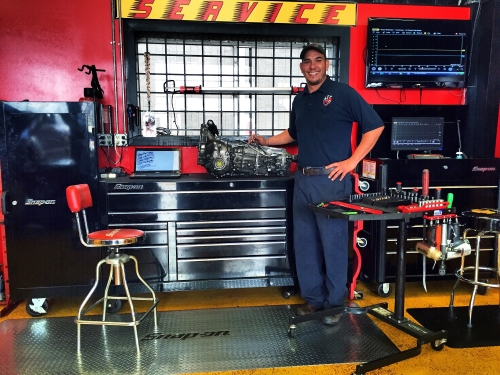
Diagnosis requires simultaneous live data monitoring of both the engine and transmission control systems during a road test that replicates the symptom. Accurate testing prevents the cost and delay of repairing the wrong system — and prevents the situation where a repair is performed, the symptom returns, and the root cause still has not been identified.
Parts Commonly Replaced After Diagnostic Confirmation
Spark Plugs and Ignition Coils
Worn or failed spark plugs and ignition coils cause cylinder misfires that produce jolts and power interruptions mistaken for transmission faults. Replacement resolves misfire-related drivability symptoms when confirmed through misfire data and ignition testing.
Fuel Injectors
Clogged or failing fuel injectors produce cylinder-specific power loss and hesitation that resembles transmission slipping or delayed engagement. Replacement or cleaning is performed after fuel injector balance testing confirms the fault.
Mass Airflow Sensor
A contaminated or failed MAF sensor causes engine hesitation and surging that mimics transmission shudder. Replacement is performed after live data confirms the sensor is outside specification.
Throttle Position Sensor or Throttle Body
A failing throttle position sensor or dirty throttle body causes hesitation and stumbling under acceleration that mimics gear engagement delay. Replacement or cleaning is performed after throttle response testing and scan data review confirm the fault.
Vacuum Lines and Intake Gaskets
Cracked vacuum lines or leaking intake gaskets introduce unmetered air into the intake manifold, causing rough idle and hesitation that closely resembles transmission shudder. Replacement is confirmed after smoke testing isolates the leak source.
Engine Control Module
In rare cases, a failed engine control module sends incorrect commands to fuel, ignition, and throttle systems, producing symptoms that mimic drivetrain faults. Replacement is performed only after module communication testing and fault isolation rule out all other causes.
What Engine Problems That Feel Like Transmission Issues Are Not
Engine-related drivability symptoms are regularly misidentified as transmission faults. Proper differential diagnosis separates the two.
Transmission Slipping
True transmission slipping produces a sustained loss of drive force with RPM rising independently of vehicle speed. Engine misfires produce brief jolts or interruptions rather than a sustained RPM-versus-speed disconnect. Live data from both systems simultaneously separates these conditions.
Delayed Gear Engagement
True delayed engagement is a hydraulic or mechanical transmission fault where the vehicle does not move after shifting into drive. Throttle sensor hesitation produces a stumble during acceleration after engagement has already occurred. The timing of the symptom relative to the gear change confirms the distinction.
Transmission Shudder
True torque converter shudder occurs at a consistent highway speed during light throttle and torque converter lockup. Engine shudder from a misfire or vacuum leak occurs across a broader RPM range and is not limited to converter lockup conditions. Confirmed through torque converter clutch command monitoring during the shudder event.
Speed and Load Patterns: When Engine Problems Feel Like Transmission Issues
The specific speed, RPM, and load conditions under which the symptom occurs are the most important factors in separating engine from transmission faults.
- At Specific RPM Regardless of Gear: A jolt or hesitation that occurs at the same engine RPM in multiple gears points to an engine fault — misfires and sensor faults follow engine RPM, not gear changes.
- Only During Gear Changes: A symptom that occurs exclusively at the moment of a gear change points to a transmission fault — clutch engagement, solenoid response, or pressure delivery.
- Highway Speed Under Light Throttle: A shudder at steady highway speed under light throttle can be either torque converter clutch or engine misfire. Torque converter clutch command monitoring during the event confirms which system is responsible.
- Symptom Occurs at Cold Start and Disappears When Warm: A hesitation or rough running that resolves as the engine warms up typically points to an engine cold-start fuel delivery or sensor fault rather than a transmission issue.
- Symptom Accompanied by Check Engine Light With Engine Codes: Engine-specific fault codes alongside drivability symptoms strongly point to the engine as the root cause, though transmission codes may also be present as secondary effects of the engine fault.
Diagnosis requires simultaneous live data monitoring of both the engine and transmission control systems during a road test that replicates the symptom.
Safety Considerations for Engine Problems That Feel Like Transmission Issues
Engine problems that produce transmission-like symptoms vary in urgency. A vehicle with an active misfire should not be driven extensively, as unburned fuel entering the exhaust can damage the catalytic converter rapidly. A vehicle with a throttle sensor or MAF fault may experience unexpected hesitation during highway merging or intersection departures, creating a real safety risk.
If the check engine light is flashing, the vehicle should not be driven until diagnosed — regardless of whether the fault is engine or transmission related. A flashing check engine light always indicates an active, severe fault.
Drivers in San Antonio experiencing hesitation, jolting, or power loss that could be engine or transmission related should schedule diagnosis promptly. When you call, note whether the symptom happens at a specific RPM, under a specific load condition, or at the exact moment of a gear change that detail helps our service team triage the appointment correctly. In most cases, diagnostic testing is completed the same day. Call Auto Service Experts at 210-495-6688 to arrange a same-day appointment.
Preventing Repeat Engine Problems That Feel Like Transmission Issues
Long-term reliability is achieved by:
- Performing scheduled spark plug and ignition coil replacement at manufacturer-specified intervals
- Cleaning or replacing the mass airflow sensor and throttle body during scheduled maintenance
- Inspecting vacuum lines and intake gaskets for cracks or deterioration at every major service
- Performing fuel injector cleaning or testing when fuel trim data indicates lean or rich conditions
- Keeping both engine and transmission control module software updated to current manufacturer calibrations
- Performing a post-repair road test that replicates the original symptom conditions before vehicle return
Preventive maintenance on both engine and transmission systems reduces the likelihood of overlap symptoms and simplifies future diagnosis.
Related Transmission Symptoms
- Transmission Slipping — Diagnosis of clutch pack wear, solenoid faults, and hydraulic pressure loss causing gear slip under acceleration.
- Check Engine Light With Transmission Code — Diagnosis of electronic, solenoid, and software faults triggering transmission-related fault codes.
- Transmission Jerks or Bangs When Shifting — Diagnosis of pressure control solenoid faults, valve body wear, and motor mount failure causing harsh shift events.
- Car Won’t Go Into Gear or Delays Going Into Drive — Diagnosis of delayed or failed engagement caused by low fluid pressure, solenoid faults, and clutch pack wear.
- Car Revs but Won’t Move — Diagnosis of complete torque converter failure, total hydraulic pressure loss, and forward clutch pack failure.
Frequently Asked Questions
How do I know if my hesitation is an engine problem or a transmission problem?
The timing and conditions of the symptom are the key. If the hesitation occurs at a specific engine RPM regardless of which gear you are in, it is more likely an engine fault. If it occurs specifically at the moment of a gear change, it is more likely a transmission fault. Structured dual-system diagnostic testing confirms which system is responsible.
Can an engine misfire feel like a transmission slip?
Yes. A misfiring cylinder produces a sudden jolt or brief power loss that is nearly identical in feel to a transmission slip or bang. Live misfire count data and cylinder contribution testing during a road test separates engine misfires from transmission engagement faults.
Can a bad throttle position sensor cause transmission problems?
Yes, indirectly. The throttle position sensor provides shift scheduling data to the transmission control module. A faulty sensor causes incorrect shift timing and hesitation that closely resembles a transmission engagement delay. Replacing the transmission based on this symptom without testing the sensor is a common misdiagnosis.
Why does my car shudder at highway speed — is it the engine or transmission?
Highway shudder at steady speed under light throttle can be either torque converter clutch shudder or an engine misfire at that RPM range. Both feel nearly identical. Torque converter clutch command monitoring during the shudder event is required to confirm which system is responsible.
Will a transmission flush fix hesitation that is actually an engine problem?
No. A transmission fluid service will not correct an engine misfire, sensor fault, or vacuum leak. Performing transmission service for an engine-caused symptom does not resolve the condition and delays the correct repair.
How Much Does It Cost to Diagnose Engine Problems That Feel Like Transmission Issues?
A full dual-system diagnostic scan and road test determines which system is at fault before any repair cost is committed. This testing prevents the far greater expense of replacing or rebuilding the wrong system based on symptom alone.
Not Sure If It’s Engine or Transmission?
Call 210-495-6688. Carlos and the team will figure out which system is responsible — before any parts are replaced.