
How Your Car’s Air Conditioning System Operates | Auto Service Experts
At Auto Service Experts, our ASE-Certified Master Technicians believe that informed drivers make better repair decisions. Understanding how your vehicle’s air conditioning system operates helps you recognize early warning signs and make informed decisions before scheduling professional auto AC repair in San Antonio.
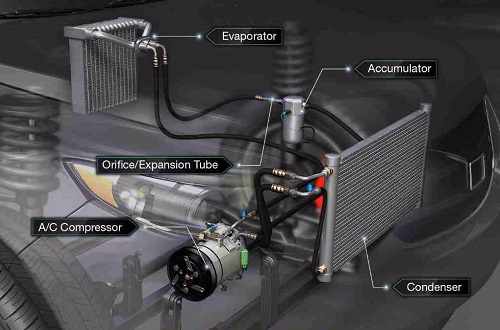
Modern automotive AC systems operate as a sealed, pressurized refrigeration cycle. When one component falls out of specification, cooling performance declines and system stress increases. Below is a clear explanation of how each major component works and how the entire system functions together.
The Refrigerant Cycle: How Heat Leaves Your Vehicle
Your car’s air conditioning system does not “create cold air.” Instead, it removes heat from the cabin and releases it outside the vehicle.
This happens through a continuous refrigerant cycle involving pressure changes and state changes between liquid and vapor.
The basic cycle follows this path:
- The compressor pressurizes the refrigerant vapor
- The condenser releases heat and converts vapor to liquid
- Expansion device lowers pressure
- The evaporator absorbs heat from the cabin air
- Refrigerant returns to the compressor
This loop repeats continuously while the AC system is operating.
At Auto Service Experts, we verify this process by measuring high-side and low-side pressures, vent temperature drop, and system response under load to ensure operation within manufacturer specifications.
High-Pressure Side Components
AC Compressor
The compressor is the driving force of the system. It pulls in low-pressure refrigerant vapor and compresses it into a high-pressure, high-temperature vapor.
Most modern compressors are belt-driven and electronically controlled through a clutch or variable displacement mechanism. The compressor must maintain proper pressure differential for the system to cool effectively.
Common compressor-related issues include:
- Internal wear or seizure
- Clutch failure
- Electrical control faults
- Debris contamination
Proper diagnosis includes evaluating clutch engagement, command signals, and system load response to prevent unnecessary compressor replacement. For a more detailed breakdown of how each part functions within the system, see our guide on car AC components explained.
AC Condenser
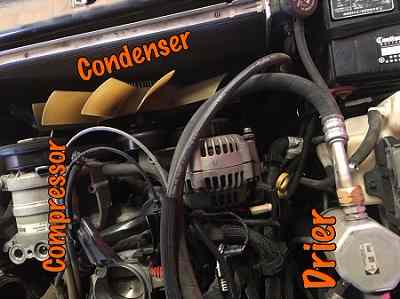
After leaving the compressor, refrigerant flows into the condenser located at the front of the vehicle.
The condenser removes heat from the high-pressure vapor by passing air across cooling fins. As heat is released, the refrigerant condenses into a high-pressure liquid.
In San Antonio’s high ambient temperatures, condenser efficiency is critical. Restricted airflow, bent fins, or debris buildup can cause elevated pressures and poor cooling performance.
Receiver-Drier (Expansion Valve Systems)
Vehicles equipped with an expansion valve system use a receiver-drier on the high-pressure side.
The receiver-drier:
- Filters debris
- Absorbs moisture using desiccant material
- Stores refrigerant before it reaches the expansion valve
Moisture contamination can form acids inside the system and damage seals or internal components. Because of this, refrigerant recovery and evacuation must be performed using EPA Section 609 certified equipment.
Low-Pressure Side Components
Expansion Valve or Orifice Tube
The expansion device regulates refrigerant flow into the evaporator.
Two common designs:
- Expansion Valve System (common in many imports and newer vehicles)
- Orifice Tube System (common in many domestic vehicles)
This component lowers refrigerant pressure rapidly, allowing it to expand and cool before entering the evaporator.
If restricted or clogged, it can cause:
- Low cooling output
- Improper pressure readings
- Evaporator freeze-up

Accumulator (Orifice Tube Systems)
Vehicles using an orifice tube system incorporate an accumulator on the low-pressure side.
The accumulator:
- Prevents liquid refrigerant from entering the compressor
- Traps moisture
- Filters contaminants
Liquid refrigerant entering the compressor can cause severe internal damage. The accumulator protects against that condition.
Evaporator
The evaporator is located inside the dashboard HVAC housing.
Low-pressure refrigerant enters the evaporator and absorbs heat from cabin air passing across its fins. As heat is absorbed, refrigerant changes from liquid to vapor.
Condensation forms on the evaporator during this process. Water draining beneath your vehicle while the AC is running is normal and not a refrigerant leak.
If airflow is restricted due to a clogged cabin filter or failing blower motor, cooling performance decreases even if refrigerant pressures are correct.
Electrical and Control Components

Modern automotive AC systems are no longer purely mechanical. They rely heavily on electronic controls, sensors, and modules to regulate compressor engagement, cooling fan operation, airflow direction, and cabin temperature accuracy.
Components that influence system operation include pressure switches, ambient temperature sensors, blend door actuators, HVAC control modules, cooling fan relays, and compressor command circuits. These components communicate with each other to maintain proper system pressures and temperature output.
When one of these electrical components fails, the symptoms can closely resemble low refrigerant or mechanical compressor problems. For example, a faulty pressure sensor may prevent compressor engagement, or a malfunctioning cooling fan relay may cause elevated system pressures at idle.
In hybrid vehicles, electrical diagnostics become even more critical because many hybrid AC compressors are electrically driven rather than belt-driven, requiring proper high-voltage safety procedures and specialized testing equipment.
At Auto Service Experts, we verify electrical command signals, sensor inputs, module outputs, and system response before recommending mechanical repairs. This ensures that electrical faults are not mistaken for refrigerant or component failures.
Modern Refrigerants and Why Proper Handling Matters
Automotive refrigerants have evolved significantly.
While older systems used R-12 and later R-134a, many modern vehicles now use R-1234yf refrigerant, which has a lower environmental impact and requires specialized recovery equipment and training.
Handling refrigerant requires EPA Section 609 certification and strict recovery procedures to protect both the vehicle and the environment. Simply adding refrigerant without properly evacuating air, measuring system pressures, or verifying leak integrity can reduce efficiency and cause long-term system damage.
At Auto Service Experts, our ASE Certified Master Technicians are EPA Section 609 certified and trained to service both R-134a and R-1234yf systems using manufacturer-approved recovery, recycling, and recharge equipment. This ensures proper refrigerant handling, accurate system charging, and full environmental compliance.
Common AC Components That Periodically Require Service
Air conditioning systems are built to operate as a closed, pressurized cycle, but over time certain components may require service due to wear, contamination, or environmental stress.
Compressors can wear internally or develop clutch engagement issues. Condensers may become restricted from road debris or suffer damage that affects heat transfer. Receiver-driers and accumulators can become saturated with moisture, reducing system protection. Expansion valves and orifice tubes may clog with debris, restricting refrigerant flow and altering pressure balance.
Evaporator cores can develop leaks, blend door actuators can fail and prevent proper temperature control, and pressure switches or sensors may send inaccurate signals to the control module. Even something as simple as a restricted cabin air filter can reduce airflow and make an otherwise healthy AC system feel weak.
Because many of these failures produce similar symptoms, accurate testing is critical. A proper diagnosis ensures that only the necessary components are replaced, preventing repeat repairs and unnecessary expense.
How AC System Operation Affects Repair Decisions
Every AC component operates as part of a larger system. Replacing a single part without evaluating system pressures, airflow, and electrical controls often leads to recurring problems.
For example, installing a new compressor without identifying contamination or airflow restrictions can result in premature failure. Adding refrigerant without locating a leak can temporarily restore cooling while allowing internal damage to continue.
A complete system evaluation typically includes pressure testing on both the high and low sides, leak detection procedures, vent temperature verification under load, electrical command signal analysis, and inspection of airflow through the condenser and evaporator.
Our professional AC inspection process follows this system-wide evaluation approach to identify root causes before recommending repairs.This approach ensures long-term reliability rather than temporary cooling.
Professional AC Diagnosis in San Antonio
Understanding how your car’s air conditioning system operates gives you the confidence to recognize abnormal behavior early.
If you notice weak airflow, warm air from the vents, inconsistent cooling, unusual compressor noise, or AC performance that improves only at highway speeds, these are indicators that system pressures, airflow, or electrical controls may be out of specification.
Scheduling a professional AC inspection at Auto Service Experts in North Central San Antonio allows our ASE Certified Master Technicians to evaluate the system thoroughly, explain findings clearly, and recommend repairs based on measured data rather than guesswork.
Our goal is not simply to make the air feel cold today, but to restore dependable cooling performance that will withstand multiple South Texas summers.
Frequently Asked Questions About How Car AC Systems Work
What does the AC compressor do in a car?
The compressor pressurizes refrigerant vapor and circulates it through the system. Without proper compressor function, the system cannot create the pressure difference required for cooling.
Why does my car AC cool better while driving?
This often indicates airflow issues at the condenser or cooling fan problems. Increased airflow at highway speeds improves heat transfer, temporarily restoring cooling performance.
How often should a car AC system be serviced?
AC systems do not require routine refrigerant “refills.” If refrigerant is low, a leak is present. A professional inspection should be performed to identify the source before recharging.
Is water under my car from the AC system normal?
Yes. Condensation from the evaporator drains under the vehicle. This is normal and not a refrigerant leak.
What is the difference between R-134a and R-1234yf?
R-1234yf is a newer refrigerant used in many modern vehicles. It has a lower global warming potential and requires specialized recovery equipment.
Why is my car AC blowing warm air?
Warm air from the vents can be caused by low refrigerant from a leak, a failing compressor, restricted airflow at the condenser, electrical control faults, or sensor issues. Because multiple components can create the same symptom, proper diagnosis involves pressure testing, leak detection, airflow inspection, and electrical system evaluation rather than simply adding refrigerant.

Have Automotive Questions?
Call now (or text on mobile) to have a conversation with an ASE Automotive Service Professional.