
Troubleshooting Automotive Air Conditioning System Leaks: Causes, Signs, and Solutions
As San Antonio summer temperatures soar, a reliable air conditioning system becomes essential for a comfortable driving experience. However, an Auto AC Freon leak can disrupt your cooling system, leaving you feeling hot and frustrated. If your vehicle’s AC is low on refrigerant, the leak must be detected and repaired before an auto AC recharge. In this article, we will explore the causes, signs, and solutions for freon leaks in your vehicle’s air conditioning system.
Do not hesitate to contact Auto Service Experts for any inquiries regarding auto AC repair. Our team of friendly technicians is dedicated to providing exceptional assistance and guidance. Should you have any concerns about the performance of your vehicle’s air conditioning system, we invite you to schedule a FREE AC check in San Antonio. Please take advantage of this opportunity to have your AC system thoroughly examined by our experts, ensuring optimal functionality and performance.
AC Recharge & Service
Your vehicle’s air conditioner does more than cool the air in the passenger cabin. It also removes moisture from the air and is necessary to defrost or defog the windows in cold or rainy weather. If the refrigerant is too low or cannot circulate properly, the AC cannot cool and remove moisture from (or condition) the air.
Automotive Air Conditioner Service Recommendations
In many cases, refilling the refrigerant (or getting an auto AC recharge) is only a temporary solution, if it fixes the issue at all. This is why it is necessary to have a thorough air conditioning system inspection to determine WHY the refrigerant is low or cannot circulate through the system adequately. There may be leaks, clogs, broken components, or a loose belt and tensioner, which must be repaired so that the problem does not repeat itself.
Auto AC Diagnostics
AC Recharge
The vehicle picured above is low on refrigerant (or Freon). It will need to have Freon added through a process known as an AC recharge. An air conditioning system is a closed unit and should not lose refrigerant over time. If levels are low, this indicates a leak somewhere within the system. Leaks can occur within the lines, hoses, connections, or cracks in components such as the compressor, condenser, or evaporator. A recharge may keep your car’s AC blowing cold for a while (depending on the size of the leak), but it does not repair the underlying issue. Because refrigerant is transparent, a dye test is often required to determine the source of the leak.
AC Dye Tests
If the vehicle is too low on Freon and the compressor will not turn on, or if the leak is small and not visible to the naked eye, you may require a dye test to determine the source of the leak. A dye test involves injecting a fluorescent dye into the car’s air conditioning system and running it until traces of the dye (visible under UV light) are seen at the leak location. The fluorescent dye helps highlight hard-to-detect leaks because refrigerant is transparent and therefore difficult to detect as it escapes the system. Dye tests are performed as a separate service.
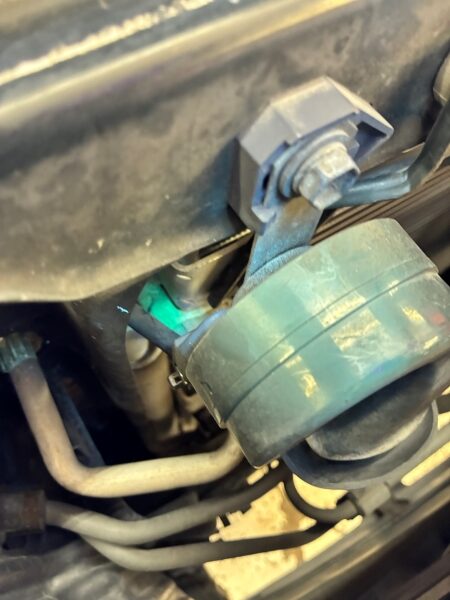
AC Leak Detection with UV Dye
In this photo, you can see a green fluorescent area under UV light. That glow comes from a special AC dye test, one of the most reliable methods we use to find hidden leaks in your vehicle’s air conditioning system.
This particular case shows a 2003 Toyota Land Cruiser with an AC hose leak at the condenser. Without the dye and UV light, this type of leak would be nearly invisible. By adding a small amount of fluorescent dye into the AC system, our technicians can quickly pinpoint the exact source of the leak, saving time and avoiding unnecessary part replacements.
Why AC Dye Tests Matter
- Accurate leak detection – pinpoints the source instead of guessing
- Prevents wasted repairs – ensures only faulty parts are replaced
- Restores cooling performance – stops refrigerant loss so your AC works properly
If your AC is blowing warm air or loses cooling power over time, it may be due to a refrigerant leak. Our ASE-Certified technicians can perform a dye test, locate the problem, and provide the right AC repair solution to keep you comfortable on the road.
Vacuum Test
Refrigerant and air are sucked from the unit with a vacuum pump, which creates a vacuum within the system. It is then monitored with a vacuum gauge for some time, possibly overnight, to detect small leaks. If the system does not hold vacuum, this indicates an AC leak. The amount of vacuum loss is recorded to determine whether the leak is minor or major.
AC Recharge
When your vehicle requires an AC recharge, it indicates an underlying issue within the AC system. The need for a recharge suggests a refrigerant leak, which compromises the system’s ability to cool effectively. At Auto Service Experts, our skilled technicians specialize in locating and diagnosing AC system leaks.
Through meticulous inspection and advanced techniques, we pinpoint the exact location of the leak and implement the necessary repairs to restore optimal performance. We prioritize the long-term functionality of your AC system, ensuring that the recharge is accompanied by comprehensive leak detection and resolution, providing you with a reliable and efficient cooling experience for the road ahead.
Understanding Freon and Its Role in Auto AC:
Freon, or refrigerant, plays a crucial role in the cooling process of your car’s air conditioning system. It absorbs heat from the cabin, cools it, and then recirculates the cool air. A freon leak occurs when this refrigerant escapes from the system, compromising its performance.
Common Causes of Freon Leaks:
- Wear and Tear: Over time, the components of your AC system may deteriorate, leading to leaks. Rubber seals, O-rings, and hoses can develop cracks or become loose, allowing freon to escape.
- Accidental Damage: Road debris, collisions, or improper maintenance procedures can damage AC components, resulting in leaks. See our full article to learn how AC components fail.
- Age and Corrosion: Older vehicles are more prone to freon leaks due to corrosion or rust that weakens the AC system’s integrity.
Signs of a Freon Leak:
Detecting a freon leak early can save you from costly repairs and ensure optimal AC performance. Look out for the following signs:
- Reduced Cooling: If your AC is blowing warm or less-cool air than usual, it could indicate a Freon leak.
- Hissing Sound: A hissing noise near the AC system may suggest a refrigerant leak. This sound is caused by freon escaping under pressure.
- Moisture or Oil Stains: Leaking freon often leaves behind an oily residue or refrigerant stains in and around the AC components.
- Frequent AC Cycling: If your AC turns on and off frequently, it could be due to low refrigerant levels caused by a leak.
It’s worth noting that while refrigerant leaks are common, diagnosing and repairing AC problems can vary by vehicle make and model. Auto Service Experts ASE Certified Master Technicians have over 20 years of experience accurately diagnosing and repairing auto AC issues. Our shop is equipped with highly specialized equipment to service all makes and models of vehicles, both foreign and domestic. We also specialize in hybrid vehicle AC system repairs.
Solutions for Refrigerant Leaks:
Professional Inspection: When a suspected refrigerant leak is detected, it is imperative to seek the expertise of a qualified automotive AC technician. Our professionally certified Auto AC technicians have the expertise and tools to quickly and accurately locate the leak.
AC Leak Detection Methods:
Auto AC mechanics employ various sophisticated techniques to locate refrigerant leaks. Among these methods, an AC dye test stands out as a widely utilized approach. The procedure unfolds as follows:
- Dye Injection: The technician introduces a small amount of specialized fluorescent dye into the AC system, specifically formulated to integrate seamlessly with the refrigerant.
- Circulation: The dye seamlessly disperses throughout the AC system, commingling with the refrigerant.
- UV Light Inspection: Once the dye has circulated adequately, the technician uses a UV light or lamp to meticulously inspect the AC system. Under UV illumination, the dye emits a radiant glow, enabling swift identification of the leak’s precise location. This method facilitates the detection of even the most minute leaks that might otherwise elude detection.
Repairing the Leak:
Upon successfully identifying the refrigerant leak, the technician proceeds with the necessary remedial measures. The exact course of action may vary depending on the location and severity of the leak. The following are common repair approaches:
- Component Replacement: If the leak originates from a compromised component, such as a seal, O-ring, or hose, we replace the faulty part with a new one that meets or exceeds OEM standards. This meticulous replacement ensures an airtight seal, effectively mitigating the risk of future refrigerant leaks.
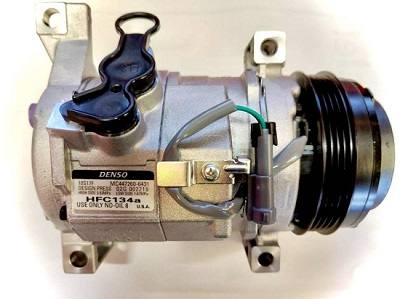
- AC Compressor Repair or Replacement: If the leak stems from a defective AC compressor, the technician meticulously assesses its condition and, if feasible, undertakes the appropriate repairs. However, in instances where the compressor is beyond repair, a complete replacement becomes necessary. ***Auto Service experts exclusively utilize brand-new, premium-grade compressors, ensuring the utmost quality and reliability in our auto AC repairs. We strictly refrain from using rebuilt or refurbished parts, emphasizing our commitment to excellence. This dedication empowers us to offer an unparalleled guarantee of longevity, as we stand behind our workmanship with a comprehensive 3-year/36,000-mile warranty encompassing both parts and labor.
- Auto AC Recharge: After the leak is rectified, the technician ensures complete evacuation of any remaining refrigerant from the system to ensure purity. Subsequently, the AC system undergoes a meticulous recharge, during which the appropriate quantity of refrigerant is added to restore optimal cooling performance.
Regular Automotive Air Conditioning System Maintenance:
Consistent maintenance of the vehicle’s AC system is paramount to avert future refrigerant leaks and other common auto AC issues. This entails periodic inspections, diligent checks of refrigerant levels, and proactive replacement of worn-out components in accordance with the manufacturer’s recommendations. Such proactive measures facilitate the early detection and resolution of potential issues before they escalate into substantial refrigerant leaks.
FREE AUTO AC CHECKS AT AUTO SERVICE EXPERTS
We are pleased to offer FREE auto AC checks as part of our commitment to providing exceptional service to our valued customers. By conducting these thorough AC checks, we can promptly identify any potential issues or signs of impending problems. This proactive approach enables us to address minor concerns before they escalate into major and costly repairs. Take advantage of our complimentary AC checks today and experience the peace of mind that comes with a properly functioning and efficient air conditioning system.
Auto AC freon leaks can disrupt your driving comfort, but with timely detection and professional repairs, you can restore your cooling system’s performance. Remember to address any signs of a freon leak promptly to avoid further damage and enjoy refreshing drives all summer long.